At its simplest, empathy is the ability to understand and share the feelings of another person. It is often described as “walking a mile in someone else’s shoes.” Unlike sympathy – which is feeling for someone – empathy involves feeling with them.
Psychology genearlly categorizes empathy in three distinct types:
Cognitive Empathy: Understanding someone’s perspective or mental state. You can intellectually grasp why they feel a certain way without necessarily feeling it yourself.
Affective (Emotional) Empathy: Physical or emotionally feeling what another person feels.
Compassionate Empathy (Empathic Concern): This goes beyond understanding an feeling; it involves spontaneous move to help or take action based on that understanding.
Why It Matters
Empathy serves as a foundational “social glue” in human interaction. In various contexts, it drives:
Effective Communication: By anticipating how others might receive a message, you can tailor your delivery to be more impactful.
Conflict Resolution: Recognizing the underlying needs of another party makes it easier to find mutually beneficial solutions.
Innovation: Identifying “pain points” or unmet needs in others is often the spark for creative problem-solving and ethical progress.
“Empathy is about finding echoes of another person in yourself.”
Dark Psychology is a field of study focused on the psychological tactics used by individuals to motivate, persuade, or manipulate others to get what they want. It primarily examines the “darker” side of human nature – those intentions and behaviors that are often predatory, self-serving, or exploitative.
Core concepts of the “Dark Triad”
In clinical and social psychology, researchers often use the Dark Triad as a framework to understand the personality types most associated with these beahaviors:
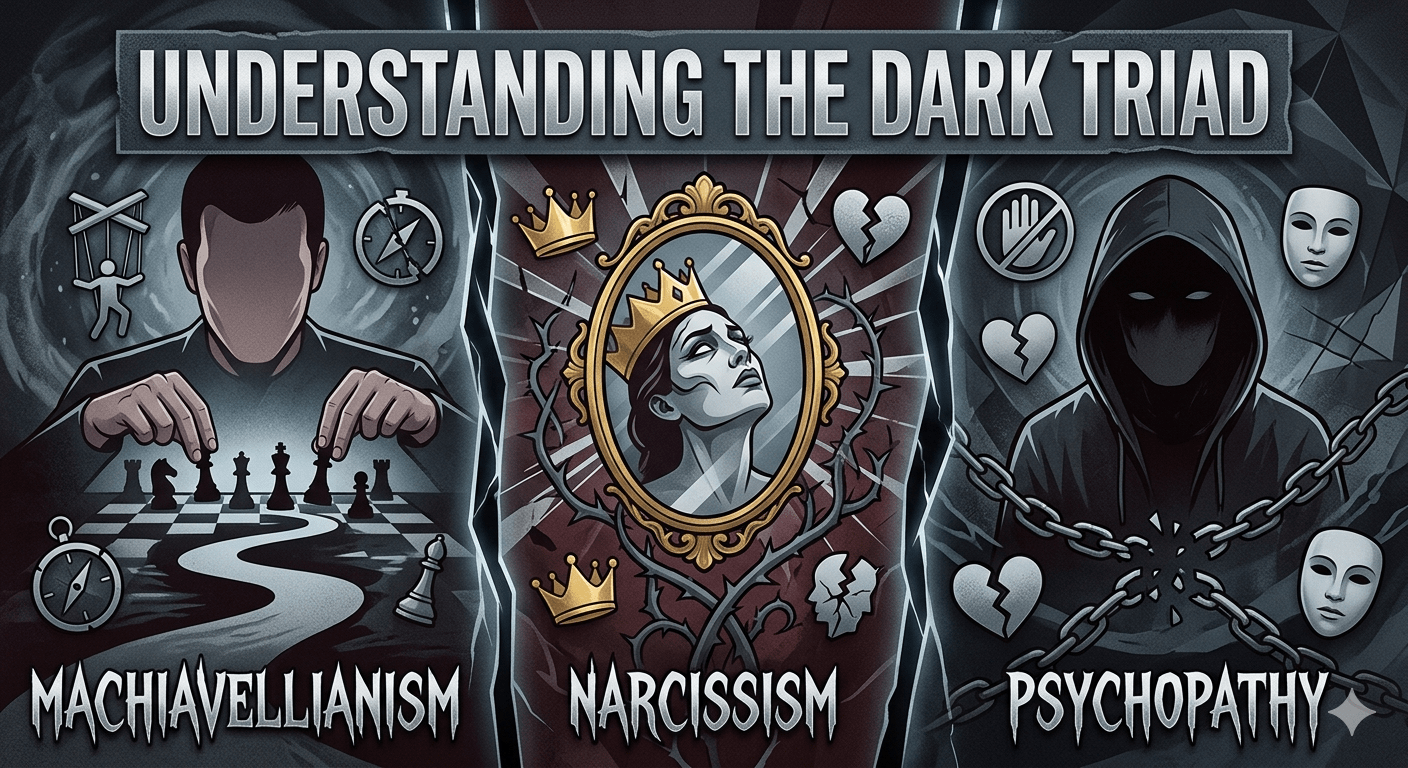
Machiavellianism: Characterized by manipulation, a cynical disregard for morality, and a focus on self-interest and personal gain.
Narcissism: Defined by grandiosity, pride, egotism, and a lack of empathy for others.
Psychopathy: Marked by enduring antisocial behavior, impulsivity, selfishness, callousness, and remorselessness.
Common TacticsUsed
Individuals utilizing dark psychology often employ specific strategies to influence others without their conscious awareness. These include:
Gaslighting Insidiously leading someone to doubt their own perceptions, memories, or sanity.
Love Bombing: Using excessive attention and affection to gain control or make someone dependent.
Reverse Psychology: Persuading someone to do something by suggesting they do the exact opposite.
Guilt Tripping: Making a person feel responsible for another’s distress to coerce them into specific action.
Subliminal Messaging: Using subtle cues or suggestions that bypass the conscious mind to influence behavior.
Ethical Boundaries
While “psychology” generally aims to understand and help, “Dark Psychology” is often viewed through the lens of influence. In business and negotiation, some elements – like understanding human bias – are used ethically to create “win-win” scenarios. However, it becomes “dark” when the intent is to harm or exploit another person for one’s own benefit without regard for their well-being.
Note: Understanding these tactics is often the best defense against them. Recognizing the signs of manipulation allows individuals to maintain their autonomy and set healthy boundaries.
Psychopathy is a neuropsychiatric disorder characterized by a specific set of personality traits and behaviors. in clinical settings, its is often categorized under Antisocial Personality Disorder (ASPD), though many experts view psychopathy as a distinct, more sever subsequent of that diagnosis.
Key Characteristics
Psychopathy is generally defined by a “triarchic” model of traits.
Boldness: Low fear, high self-assurance, and social efficacy.
Disinhibition: Poor impulse control and lack of planfulness.
Meanness: A lack of empathy, deficient emotion attachments, and the use of cruelty to gain empowerment.
Clinical Perspective
While “psychopath” is a common term, clinicians often use the PCL-R(Psychopathy Checklist-Revised) to measure the condition across to main factors:
Factor
Traits
Factor 1: Interpersonal/Affective
Glibness, superficial charm, grandiosity, pathological lying, and lack of remorse or empathy.
Factor 2: Lifestyle/Antisocial
Need for stimulation, parasitic lifestyle, impulsivity, and early behavioral problems.
Potential Biological Roots
Research suggests that psychopathy involves distinct neurological differences, particularly in the amygdala (which processes fear and emotion) and the prefrontal cortex (responsible for decision-making and social control). These differences can result in a diminished “emotional brake” when considering the consequence of actions.
Note: It is a common misconception that all psychopaths are violent. Many individuals with these traits navigate society successfully in high-stakes environments, such as corporate leadership or emergency services, where their “boldness” and “coolness under pressure” can be viewed as assets.
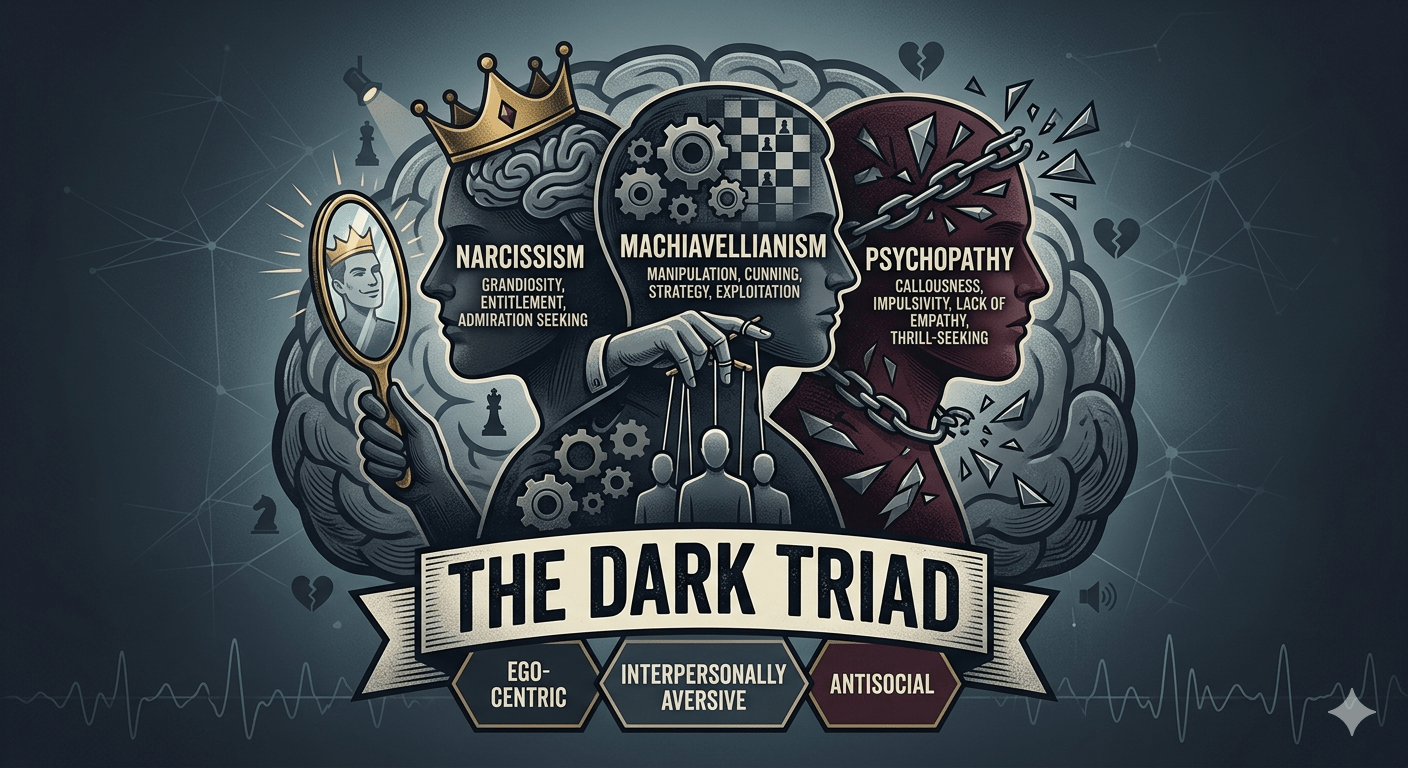
The Dark Triad is a psychological framework that describes three distinct yet overlapping personality traits: Machiavellianism, Narcissism, and Psychopathy. These traits are considered “Dark” because of their malevolent qualities, such as self-promotion, emotional coldness, and duplicity.
While these terms are often used clinically, the Dark Triad specifically studies them in a non-clinical context meaning they are viewed as personality spectrums found in the general population.
The Three Pillars
1.) Machiavellianism
Named after Niccolò Machiavelli, this trait is characterized by manipulation and exploitation.
Key Features: A cynical view of human nature, a focus on self-interest, and a “the ends justify the means” mentality.
Behavior: These individuals are often strategic, patient, and highly calculated in their social interactions.
2.) Narcissism
This trait is defined by grandiosity and entitlement.
Key Features: An inflated sense of self-importance, a constant need for admiration, and a lack of empathy.
Behavior: Narcissists often seek leadership roles to validate their superiority and can become aggressive when their ego is threatened.
3.) Psychopathy
In the context of the Dark Triad, this refers to impulsivity and callousness.
Key Features: Low empathy, high thrill-seeking behavior, and a lack of remorse or guilt.
Behavior: Psychopaths are often perceived as charming but are prone to risk-taking and violating social norms without hesitation.
The Common Core
While each trait is unique, they share a common core of callousness and disagreeableness. Research suggests that people high in Dark Triad traits are often
Low in Empathy: They struggle to connect with or care about the feelings of others.
Interpersonal Aversive: They view others as tools to be used rather than individuals to be respected/
Highly Competitive: They prioritize winning or gaining status over collaboration.
Why it Matters
Understanding the Dark Triad is useful in fields like organizational psychology and criminology. It helps identify behaviors that may lead to toxic environments, unethical decision-making, or social friction. However, it is important to remember that having a “high score” in one area dos not necessarily equate to a clinical diagnosis; it simply reflects a personality lean toward these behaviors.
Machiavellianism is a political and psychological concept centered on the use of cunning, pragmatism, and duplicity to maintain power or achieve specific goals. The term originates form the work of NiccolòMachiavelli, a 16th-centruy Italian diplomat and philosopher.
Philosophical Origins
The concept is primarily rooted in Machiavelli’s most famous work, The Prince (1513). In it, he argued that ruler’s success depends on the ability to prioritize results over moral or religious ideals. Key tenets include.
1.) The End Justifies the Means: Actions that might be considered immoral (like lying or betrayal) are acceptable if they preserve the state or the leaders authority.
2.) Realpolitik: Politics should be based on practical realities and power dynamics rather than “how things ought to be.”
3.) Pragmatic Cruelty: Machiavelli suggested it is better for a leader to be feared than loved, provided they are not hated, as fear is more reliable tool for control.
Modern Psychological Context
In modern psychology, Machiavellianism is studied as a personality trait characterized by a cold, calculated approach to social interaction. It is one-third of the “Dark Triad” (alongside narcissism and psychopathy).
Common Characteristics:
1.) Interpersonal Manipulation: A tendency to exploit others for personal gain.
2.) Cynicism: A belief that people are fundamentally self-serving and untrustworthy.
3.) Strategic Focus: An intense focus on long-term goals, often ignoring immediate emotional or ethical consequences.
4.) Emotional Detachment: The ability to remain “cool” and unaffected by others’ feelings when making decisions.
Machiavellianism vs. Leadership
While the term is often used as an insult, in a professional or strategic context, it is sometimes viewed as high-level social intelligence. Effective strategists often use “soft” Machiavellianism such as building alliances or controlling information to navigate complex systems and achieve vison-driven outcomes without necessarily being “evil.”
At its core, manipulation is a form of social influence that aims to change the behavior or perception of others through indirect, deceptive, or underhanded tactics. While social influence occurs in almost every interaction (like a friend persuading you to see a movie), manipulation is typically characterized by lack of transparency and an imbalance of power or benefit.
Core Characteristics
Manipulation usually involves three specific elements
1.) Deception: Hiding the true intention or flavoring the truth to steer someone’s reaction.
2.) Exploitation: Using a person’s vulnerabilities (fears, guilt, or desire for approval) to achiever a specific goal.
3.) Lack of Reciprocity: The manipulator benefits, often at the expense of the other party’s well-being or autonomy.
Common Tactics
Psychologists often identify several “red flag” behaviors used in manipulative dynamics:
1.) Gaslighting: Making someone question their own reality, memory, or perceptions.
2.) Guilt Tripping: Using a person’s sese of responsibility or morality to make them feel obligated to comply.
3.) Love Bombing: Overwhelming someone with affection or praise to gain trust and create dependency before switching to controlling behavior.
4.) The Silent Treatment: Using silence as a punishment to force the other person to “apologize” or cave in to demands.
5.) Moving The Goalposts: Constantly changing the criteria for success or satisfaction so the other person is always trying to catch up.
Manipulation vs. Persuasion
It is helpful to distinguish between healthy persuasion and harmful manipulation:
Feature
Persuasion
Manipulation
Intent
Transparent and shared.
Hidden or self-serving.
Method
Logic, emotion, and facts.
Deceit, pressure, or guilt.
Choice
Respects the other’s right to say “no.”
Pressure or “no” is met with backlash.
Outcome
Ideally “Win-Win.”
Often “Win-Lose.”
Why People Manipulate
Manipulation is often a defense mechanism or learned behavior. It may stem from a need for control, an inability to communicate needs directly, or a fear of vulnerability. In professional or market contexts, it can also be a calculated strategy to maximize gain without regard for ethics.
Understanding these dynamics is the first step in maintaining healthy boundaries and ensuring that interactions remain mutually beneficial and respectful.
Narcissism is a multifaceted term used to describe a range of personality traits involving self-centeredness, a need for admiration, and lack of empathy for others. It exists on a spectrum, from healthy self-esteem to clinical menta health condition
1.) The Spectrum of Narcissism
It is helpful to distinguish between normal personality traits and linical diagnoses:
Healthy Narcissism: Having a realistic sense of self-worth, taking pride in accomplishments, and maintaining a healthy level of self-interest while still caring about others.
Narcissistic Traits: Occasional behaviors such as vanity, a desire for attention, or overconfidence. Most people exhibit these at various points in their lives.
Narcissistic Personality Disorder (NPD): A form of diagnosis characterized by a pervasive pattern of grandiosity, a constant need for external validation, and an inability to recognize the feelings or needs of others.
2. Common Characteristics
In clinical or behavioral psychology, nariccissm is often identified by several key markers:
Trait
Description
Grandiosity
An exaggerated sense of self-importance or uniqueness.
Sense of Entitlement
Unreasonable expectations of favorable treatment or automatic compliance.
Lack of Empathy
Difficulty identifying with or validating the emotions and needs of others.
Need for Admiration
A constant requirement for excessive praise and attention.
Exploitative Behavior
Taking advantage of others to achieve one’s own ends.
3. Possible Origins
Psychologists generally believe narcissism stems from a complex interaction of factors:
Environment: Parenting styles that involve either excessive pampering or extreme criticism/neglect.
Genetics: Inherited characteristics that influence temparament.
Neurobiology: The connection between the brain, thinking, and behavior.
4. Psychological Perspectiver
In modern psychology, many experts view narcissism not as “excessive self-love,” but rather as a fragile self-image. Individuals with high levels of narcissism often rely on external “narcissistic supply” (praise and success) to mask deep-seated insecurities or a vulnerable ego.
Note: Only a licensed mental health professional can diagnose Narcissistic Personality Disorder (NPD). It is distinct from simply being confident or amibtious.
I completed a marathon. This was on the 20th of April 2026. I walked 28KM one direction and 28KM the other. I walked one direction toward Riga from my hometown while listening to music until my phone was on 1% and then walked back.
I bought a 2L bottle of coke and drank it on the side of the highway until it was empty and had a few power naps. My legs were killing me but I knew I had to walk home and I had no other option. I was in bed for the next two days just chilling on my phone and I’ve never felt more mentally stressed than I did those two days.
It was 56KM total that day and It took me 12 hours. I wasn’t jogging, I wasn’t running, I was simply walking.
I’ve set a lot of posts to draft until I feel the need to publish them but making this blog has been a big part of the reason I could push myself to accomplish something like that.
Today I have closed 2 successful trades at a 10.61% ROI and a 13.81% ROI. I still have 2 orders which have not yet triggered and I think that I should cancel them both and enter new positions again on 4 different coins.
100x Leverage, 4,5,6,7% per coin each, that’s 4% on your first coin, 5% on your second coin, 6% on your third coin and 7% on your fourth coin, that ads up to 23%,
What if the next 4 coins i place I do, 3%, 4%, 5,% and 6%? that’s 18%
In my opinion the first tactic is better, using 4,5,6,7, which adds up to 23% because when you open a position at 4% of your total portfolio value, you portfolio value get’s reduced to 96% as you have now opened a position of 4%.
I Just Opened 4 Positions
I’ve been organizing my shelves, had a shower, wrote this blog, played a game of counter strike and now I think I need to distract myself with something for about 45 minutes and check back in on my crypto portfolio.
It’s currently 13:22 and in 45 minutes it’s going to be 14:07 So I will set an alarm for 14:07 to check my crypto account. Last time I made a so called diary entry I made 3 different parts for the same day, and I think It would be better if I just finish this entry instead of splitting it into parts.
I’m going to tidy my room.
Do I want the whole world to know that? Am I going to publish this post now? Oh wait no, I changed my mind, I’m going to play some counter strike 2 I didn’t publish part 3 of Learning About Crypto
14:57 Crypto Update
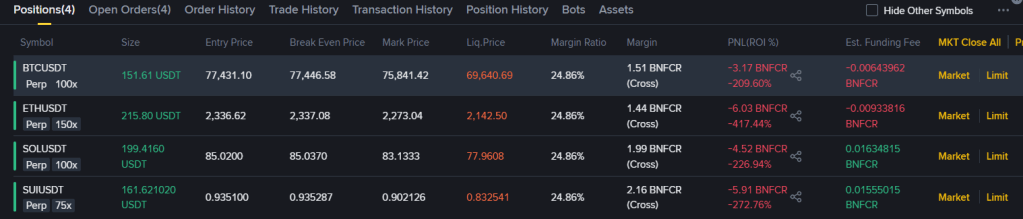
Hello guys, I’m back from playing a game of counter strike and organizing my room a little bit. I have 3 open positions, ETH, SOL, Sui, averaging at about 15% of my total portfolio. I do not have a stop loss set, and I’m not going to set one. I should have bought even lower, It’s starting to somewhat recover. I’m going to check in again in another 45 minutes or so.
I really gotta shave my beard, I’m going to get to it and then get back to tidying my room or something.
I’m really in the mood to play some league of legends.
Here is the playlist of songs I’ve been making today:
15:45 Update
Hello.
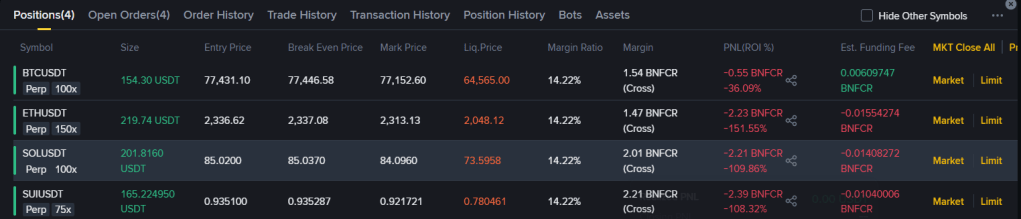
This is the current state of my portfolio.
Obviously if I sell then I will automatically take a loss. There is no reason for me to sell because my strategy involves a no stop loss -500% Liquidation risk. I can allow the coins to dip bellow -499% but if it hits any lower then my whole portfolio gets liquidated.
I just shaved my stache and beard, and now It’s time to play some league of legends.
16:43 Update
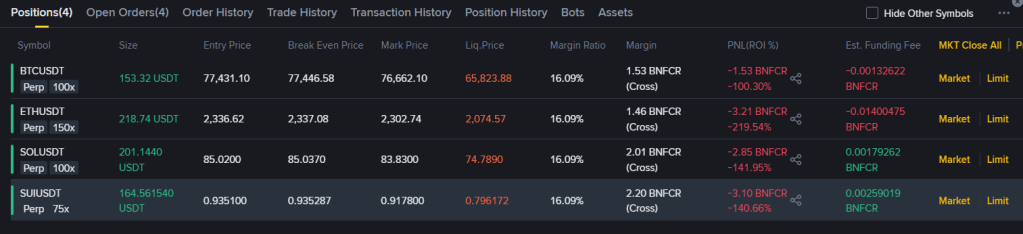
This is the current state of my portfolio
One bad trade can make me lose everything so I really don’t that this strategy is very good. I need to set some type of stop loss. Trading at 100x Leverage is very risky and you need to know what you’re doing.
Do I know what I am doing? Only To the best of my ability. Trading is a game of skill and the more you practice the better you get. According to Alex Gonzales It’s important to journal your trades.
This blog is my life, I used to journal on notepads to improve myself and it worked. But I would also read a lot of books and it inspired me and improved the state of my life in ways I cannot even comprehend. In my opinion the brain is complex, and so is memory. But I know that memory is goal oriented; meaning that we remember things in relation to our goals. So when I read something in a book, I don’t remember everything I’ve read but I remember the things related to accomplishing my goals.
I’m in no position to just lay back and relax and act like I’m in a comfortable spot to be sitting and playing video games. Or am I?
My calendar is still empty since the last time I said I was going to update it.
I’m not really sure what to do with my room, I’m just emptying all the shelves and am planning on re-organizing them neatly and categorize the sections so that everything makes sense.
I have mostly boxes and clothes
17:34 Update
This is the state of my portfolio.
Its definitely recovering, just wanted to check in before I set another 45 minute timer and clean my room a little bit. I got the music in the background and I’m making a playlist here it is.
Got the clothes on washing so I need to clear out the area so that I can hang them gonna get to it.
18:33 Update
This is the current state of my portfolio
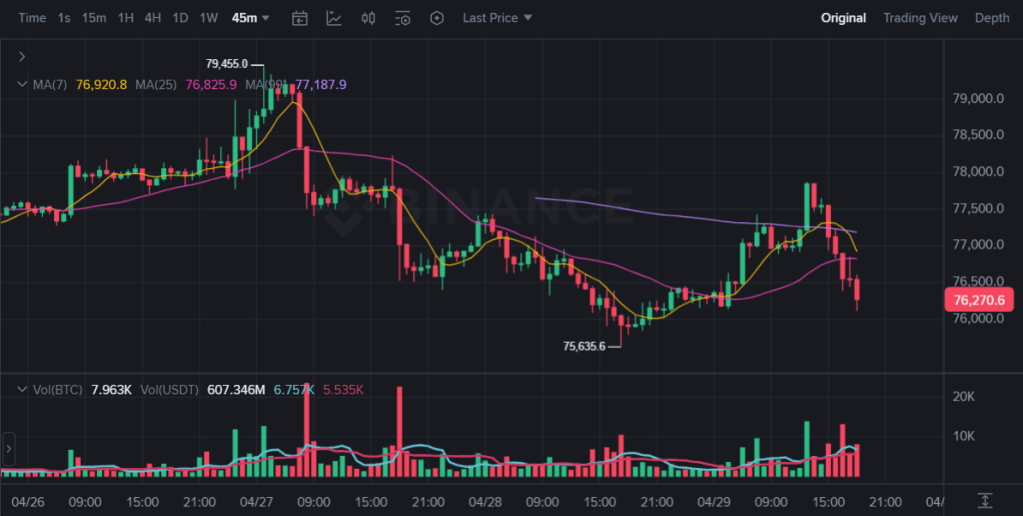
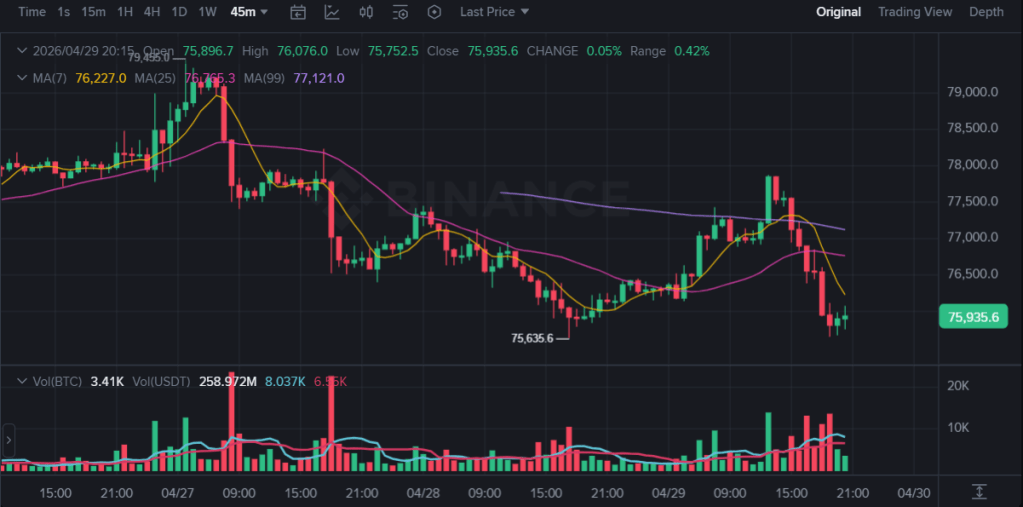
This is how BTC Graph Is looking right now.
I’m not going to worry about it much because the only thing I can do is wait or sell and accept the loss.
Still gotta clean some space for the washing. Almost done, but got no time to waste. I’ll be back in another 45 minutes and give you another update on todays crypto adventure.
19:31 Update
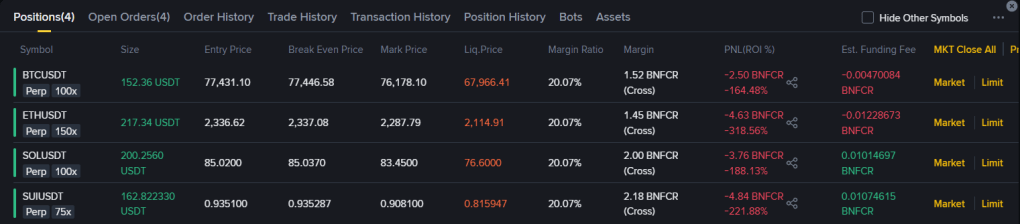
This is the state of my portfolio:
It is clear that without a stop loss, your portfolio is inevitably going to dissolve.
20:42 Update
This is how my portfolio is looking now:
This is how the graph is looking:
To me, It’s starting to look like it’s bouncing back up.
Still seems far from liquidation.
21:10 Margin Call Update/Liquidated
My ROI reached -500% I got a Notification on my phone and and 2 emails, one for margin call warning and the other for liquidation.
All my portfolio blown. It was a nice run. I do believe that sharing my journey with everyone else is worthwhile as you can learn from my lessons as much as I can by creating these posts for myself and anyone interested.
When It comes to trading crypto; one thing is certain, it’s not about the amount of money you have but about the percentages when it comes to defining skill.
It’s easy to make more money if you have more money and it is also easy to lose a lot of money if you have a lot of money.
In the part one, I drew inspiration from bitcoin as I locked in a position and while writing the post; tried to get my focus straight on what I aim to accomplish.
For the record: It’s currently 5:33 AM and my trade order was confirmed at 3:07. I just watched as my ROI fluctuated from around 4.69% to 2.38% back now to 3.00% and so on it goes.
The question here is: What TP/ROI% is worthwhile for my trading frequency and what trading frequency is the most logical/sensible.
Since I witnessed my ROI jump to 4.69% then it is was possible for bitcoin to reach it once.
I really don’t want to start taking screenshots and analyzing graphs but right now The Value of Bitcoin is 77,513.30 as of writing this sentence and the highest visible peak at a zoomed in 1D graph is 79,490.0
I would like to move away from bitcoin for now.
This posts is supposed to be about Ethereum but I am rambling on about the fluctuation of my open bitcoin position.
But it is relevant, because my portfolio is 1/5 bitcoin, I have 4/5 left but I also need to eat food.
On the contrary, I was supposed to lock in my positions as soon as I deposited the money on to my Binance account. Therefore all money deposited is money I am ready to risk for potential profit.
The question which gets brought up again is how much profit do I aim go gain?
My Bitcoin ROI is down -5.47% at 05:50 AM and It makes me re-consider whether I should risk opening a position for Ethereum.
If 10% annual ROI is considered exceptionally high by google and the bitcoin ROI is fluctuating between -6.00% to -4.69% it will most likely jump to 5.00% ROI at 100x leverage with 1/5 of my total portfolio value.
The rest is currently BNFCR (Binance futures credits) which are used for buying future coin holdings and the reason I like it is because it makes the ROI more volatile and for anyone with working class income the opportunity to practice gaining skills and experience trading cryptocurrencies and make multiplied amounts of profit as well as losses.
Where there is a will, there is a way.
For me, I believe that this quote means that if you truly desire to accomplish something and are destined for it you will achieve it and get there.
Bitcoin ROI has dipped to 7.48% and It’s time to leave the tab and get to talking about Ethereum
On to Ethereum
Let’s look at the graph, the highest recent peak was 2,319.59 and It’s currently at 2,313.58.
When I was ignorant on much thought it actually takes and just blindly locked in trades based on intuition I would be on Binance very frequently just locking one trade in after another.
I don’t think overanalyzing the market is good either. I’d imagine that a mix of a reasonable amount of market analysis and intuition from experience is necessary for closing profitable trades.
As I’m scrolling down the page the bitcoin position appears again and it’s -0.48%, it literally just fell to -3.4% which shows how quickly the ROI can change.
I’m very cautious about how I approach my next trade because I’ve lost large amounts very quickly before.
Currently the probability of liquidation is low because I have 1/5 of my portfolio with my bitcoin position meaning that instead of going -100% ROI before Liquidation, based on assumptions from past experience, I can hold my position open until it reaches -500% ROI as long as I have 4/5 in BNFCR.
If I open another trade with 1/5 of my portfolio then I have 2/5 in cryptocurrencies meaning that instead of -500% ROI until Liquidation, the volatility trench.
As I’m writing this post and making music playlists the ROI dropped to 18.45%, with 100x leverage that is 0.18% dip in the market. Now it’s at 14.96%. In the beginning of this post collection it was moving from +4% to -6% so a dip close to -20% might seem alarming but since we have only 1/5 of our portfolio in the market that leaves the other 4/5 for collateral damage of -500% ROI.
Reducing my collateral ROI from -500% to even -400% seems like a huge sacrifice.
Now that It’s at -28% It get’s me excited because It can just as easily bounce back to +28%
In summary
If bitcoin drops by 5% my portfolio gets liquidated. Bitcoin is a fairly solid holding coin with very mild movements compared to other coins. It is the most expensive coin available on the market and if you do not have enough to buy a single bitcoin which currently is valued at 77,340USDT which is equivalent to 77,340 USD based on a 1:1 peg. You can always buy fractions which is exactly what one would do if they weren’t interested in buying one.
Before I leave
I am going to set my TP (Take Profit) to 20% as I believe that by the next time I check Binance there is a possibility for it to reach that number as it’s been -28% therefore based on my logic 20% seems reasonable to me.








 ZutisBljeg