

Introduction
At its simplest, fasting is the voluntary abstinence from some or all food, drink or both, for a specific period of time.
When you eat, your body is in a “fed” state, focusing on digesting food and storing energy. When you fast, your body transitions into a “fasted” state, switching from storing energy to burning it.
What Happens Biologically?
Your body undergoes distinct hormonal and metabolic shifts when you stop consuming calories.
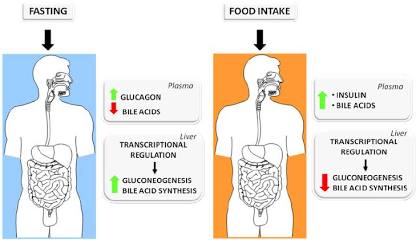
As shown in the metabolic diagram, the transition between fasting and food intake triggers opposite cellular signals:
- Insulin Drops: When you eat, insulin spikes to help store glucose. During a fast, insulin levels drop significantly, which signals the body to start burning stored fat for fuel.
- Glucagon Rises: The liver releases glucagon to mobilize stored glucose (glycogen). Once those glucose reserves run low, the liver increases gluconeogenesis (creating glucose from non-carbohydrate sources) and eventually switches to producing ketones from fat.
- Autophagy Triggers: After an extended fast (typically 16-24+ hours), cells initiate a “housecleaning” process called autophagy, where they degrade and recycle damaged proteins and old cellular components.
Common Methods of Fasting
Fasting generally falls into three main categories based on how the time is structured:
1.) Intermittent Fasting (IF)
Cycling between specific windows of eating and fasting daily or weekly. Common splits include 16:8 (fasting for 16 hours, eating withing an 8-hour window) or 5:2: (eating normally for 5 days, cutting calories drastically for 2 days).
2.) Extended Fasting
Fasting for 24 to 72 hours or more. This is typically done for deeper metabolic or therapeutic reasons and requires careful attention to hydration and electrolytes.
3.) Religious/Spiritual Fasting
Practiced for centuries across major cultures and religions, such as Ramadan (Islam), Yom Kippur (Judaism), or various fasting periods in Christianity, Buddhism, and Hinduism.

 ZutisBljeg