
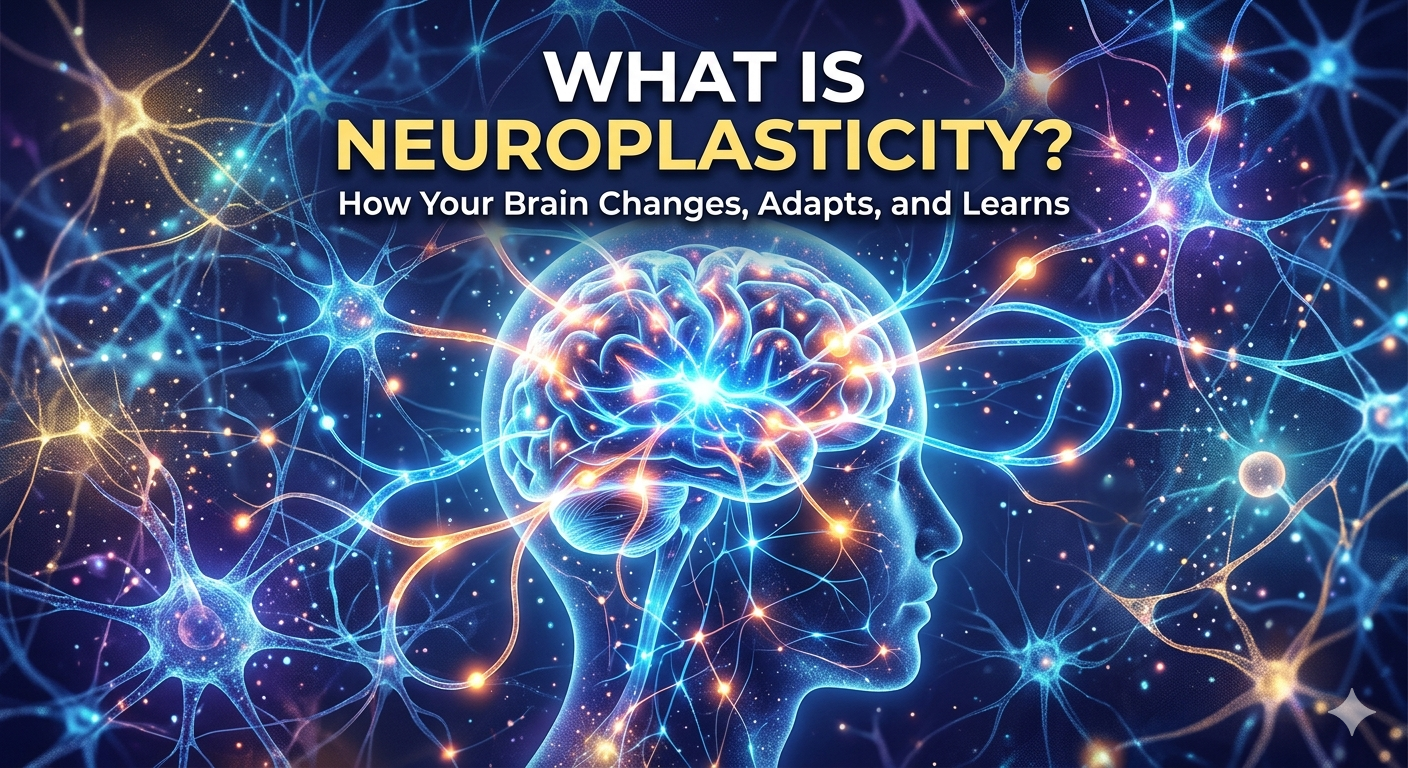
The Brain’s Ability to Rewire
Neuroplasticity (or brain plasticity) is the brain’s ability to recognize itself by forming new neural connections throughout life. It allows the neurons (nerve cells) in the brain to compensate for injury and disease and to adjust their activities in response to new situations or changes in their environment.
How it Works
Neuroplasticity occurs through several processes that range from individual neurol changes to large-scale “remapping.”
- Synaptic Plasticity: This happens at the microscopic level. When you learn something new, the communication between specific neurons (synapses) gets stronger. If you stop using a certain skill, those connections weaken.
- Structural Plasticity: The brain can actually change its physical structure. It can grow new neurons (neurogenesis) or create entirely new branches (dendrites) to connect with other cells.
- Functional Plasticity: If one area of the brain is damaged, another part can sometimes take over the functions of the damaged area.
Two Main Types
| Type | Description | Example |
| Structural | Physical changes in the brain’s gray matter or connections | An athlete’s motor cortex thickening after years of training. |
| Functional | The movement of functions from a damaged area to an undamaged area. | A stroke survivor relearning how to speak using a different part of the brain. |
Key Takeaways
1.) Learning and Memory: Every time you learn a new skill or memorize a fact, your brain is physically changing.
2.) Environment Matters: A stimulating environment with new challenges encourages more “plastic” activity.
3.) Not Always Positive: While it helps us learn, neuroplasticity can also be responsible for negative habits or chronic pathways if the brain “learns” those patterns too well.
The “Use It or Lose It” Principle: The brain is highly efficient. It strengthens the neural pathways you use often and prunes away the ones you don’t, ensuring energy is spent on your most frequent activities.

 ZutisBljeg